

Building Performance & Diagnostics
MSBPD | PhD-BPD
Robert L. Preger Intelligent Workplace (IW). Credit: Karl Backus
Our graduate programs in Building Performance & Diagnostics (BPD) are top-ranked building science degree programs dedicated to advancing high-performance buildings and communities for a more resilient and sustainable future.
Jump To...
Associate Professor in Building Technology, BPD Track Chair & CBPD Co-Director

Design the Future of Intelligent Buildings
Buildings are becoming smarter. Be the one who leads the transformation.
At Carnegie Mellon University's Building Performance & Diagnostics (BPD) program, you'll combine building science with AI, digital twins, advanced simulation, and emerging technologies to create buildings that are intelligent, resilient, and ready for the future.
Help Solve the Climate Challenge
The future of climate action starts with better buildings.
Buildings shape how we use energy, reduce carbon emissions, and adapt to a changing world. CMU's BPD program prepares you to develop innovative, data-driven solutions that create sustainable, resilient, and high-performing buildings and communities.
Design Buildings That Improve Lives
The best buildings don't just perform — they transform how people live, work, and thrive.
From healthier indoor environments to immersive technologies and human-centered design, CMU's BPD program prepares you to create spaces that enhance health, well-being, productivity, and quality of life.
Program Overview
Carnegie Mellon's Master of Science in Building Performance & Diagnostics (MSBPD) and Ph.D. in Building Performance & Diagnostics (PhD-BPD) are top-ranked building science degree programs dedicated to advancing high-performance buildings and communities for a more resilient and sustainable future. The BPD programs are founded on the premise that the integrated design of building and community systems is critical for environmental sustainability and human health and productivity. The interdisciplinary programs provide students with the necessary skills and knowledge to excel in the dynamic field of building performance. In this program, students explore the technical aspects of building systems, while investigating the broader implications of their designs on environmental sustainability, human well-being, and architectural aesthetics.
The MSBPD is a two-year program for architecture and engineering graduates committed to advancing the quality of the built environment for human health and ecological sustainability. MSBPD graduates have successful careers in design and engineering practice, industry, government, consulting and nonprofit sectors, where they design, catalyze, and quantify high-performance buildings and communities.
Courses in the MSBPD program provide four (4) semesters of intensive learning about sustainability science, technology, tools, data acquisition and analytics, sustainable social science and statistics, as well as sustainability economics and policy. Students take courses across the disciplines at Carnegie Mellon. Those who come to CMU with comparable prerequisites can appeal to place out of courses and select electives across campus.
The MSBPD thesis is an invaluable opportunity to collaborate with faculty or pursue independent research expertise with a focus on the greatest needs and opportunities for future work. These projects have included advanced building system innovations and evaluation, energy data analytics, life-cycle justifications for high-performance buildings, computational tools for sustainability, design for sustainable cities, and industry- and government-based research projects.
The BPD programs are a cohort of classmates from around the world, sharing learning experiences with dedicated faculty in purposefully small classes. The programs are a good fit for those who seek quantitative depth in building and urban design, building performance, building science, computational design and design invention, leading to sustainability positions in professional practice, research, environmental consulting, industry and government.
Center for Building Performance and Diagnostics
The Center for Building Performance and Diagnostics (CBPD) conducts research for international governments and industries on high-performance building system design and operations; the office, school, healthcare and urban settings of the future; design for climate, energy, resource conservation, health and productivity; environmental assessment and post-occupancy evaluation feedback for design and operation; and the financial, natural and human capital benefits of investing in high-performance built environments. Read more about the CBPD's research projects on the CBPD webpage.
The CBPD is housed in the Robert L. Preger Intelligent Workplace (IW), a living laboratory of advances in building enclosure, mechanical, lighting, telecommunications and interior systems, as well as the next generation of building controls to support human health and productivity and the highest level of environmental sustainability.
Program Pedagogy
Pedagogically, the BPD programs focus on the following objectives:
- Integrated Design — Advanced Building and Urban Systems for Climate and Carbon: Students develop a comprehensive understanding of the technical aspects of building performance, including energy efficiency, HVAC systems, building materials, building envelope design, indoor air quality, lighting systems, and sustainable construction techniques. Through a combination of coursework and real-world projects, students gain a deep understanding of how building performance intersects with various disciplines such as design, engineering, environmental science and urban planning.
- Human Factors and Building Science for Health and Equity in the Built Environment: The program emphasizes the importance of human factors and building science in promoting health and equity within the built environment. Students learn about sustainable design practices, focusing on reducing carbon emissions, minimizing resource consumption, and promoting renewable energy solutions.
- Performance Assessment and AI: Students learn how to evaluate the performance of buildings through comprehensive analysis tools and methodologies, enabling them to optimize designs for maximum efficiency and effectiveness. This includes integrating emerging technologies such as artificial intelligence (AI) to enhance performance assessment processes.
- Thesis: Through hands-on projects and collaborative exercises, students are encouraged to explore innovative solutions to real-world challenges in building performance, fostering creativity and critical thinking skills, culminating in a thesis project that demonstrates their advanced understanding of building performance concepts and showcases their ability to design sustainable solutions to complex architectural challenges.
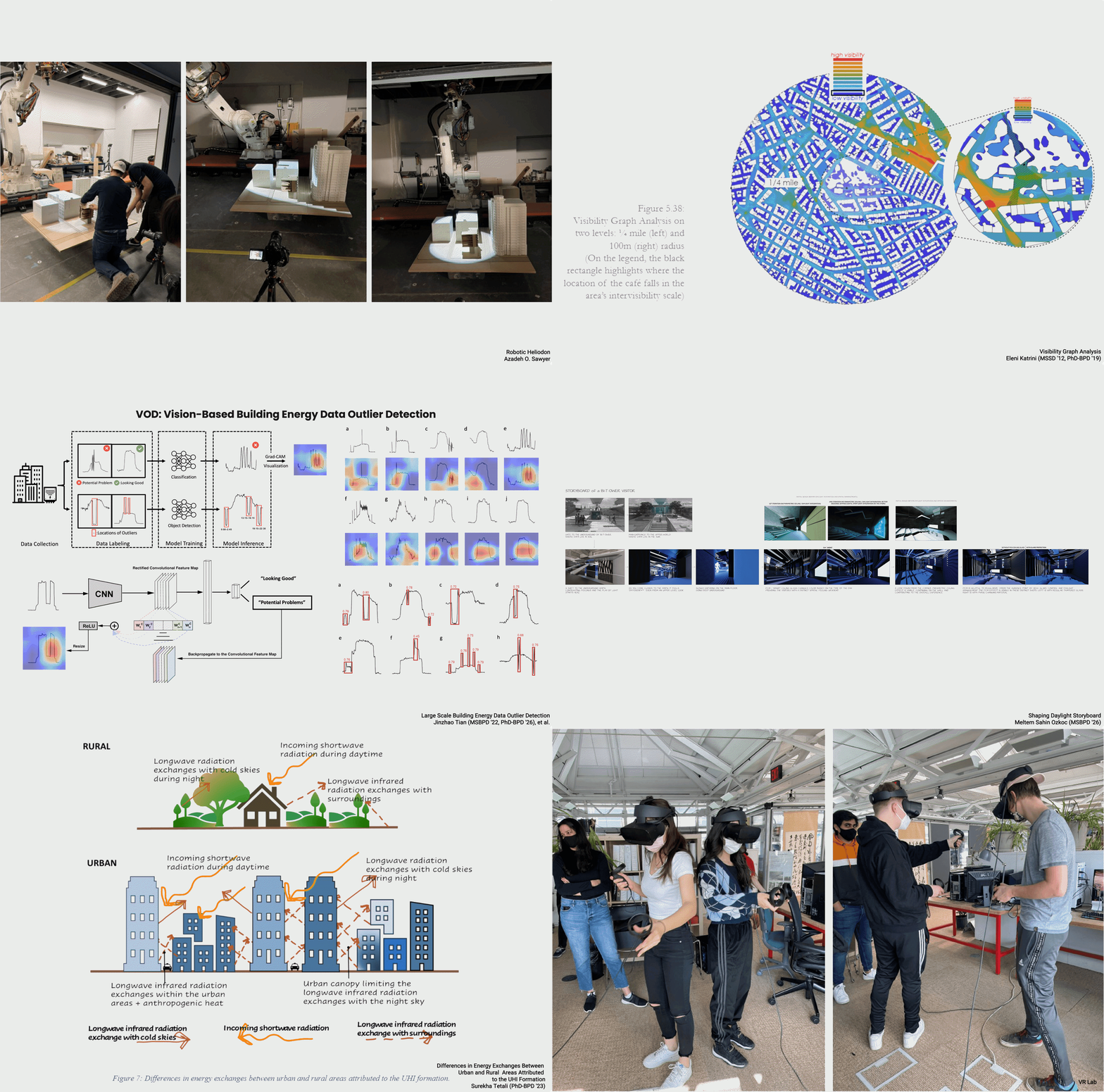
BPD Student Work
Program Curriculum
The principles of advanced building technologies and integrated systems are central across both the master's and Ph.D. programs, addressing the demand for design experts skilled in innovative building and urban systems that are essential for tackling climate challenges and improving quality of life.
Building science fundamentals are also integral to the programs, covering topics including material science, heat, light, sound, air, and human factors. This comprehensive knowledge base equips students to address a wide range of challenges in architectural design and building performance.
We focus on developing expertise in performance assessment tools, including AI and emerging sustainability design standards. This strategic focus gives our graduates a competitive edge and prepares them to thrive in a rapidly evolving industry.
Our core curriculum offers a building science and research-oriented program with the technical depth required for careers in sustainability-focused practice, environmental research, consulting, the building industry, higher education, or, for master's students, pursuing a Ph.D. The degrees are designed for those seeking quantitative rigor in areas such as building and urban design, building performance, computational design and design innovation, leading to roles in professional practice, research, environmental consulting, industry and government.
Program Structure:
- Core Courses: The curriculum includes core courses covering fundamental concepts in building science, environmental systems, and sustainable design principles.
- Electives: Students have the flexibility to choose from a range of elective courses tailored to their specific interests, such as advanced energy modeling, passive design strategies, and green building certification programs.
- Practical Projects: Throughout the program, students engage in practical projects that challenge them to apply their knowledge to real-world scenarios, working collaboratively with peers and industry professionals.
- Thesis Project: In their final year, students complete a thesis project that demonstrates their advanced understanding of building performance concepts, showcasing their ability to design innovative and sustainable solutions to complex architectural challenges.
The MSBPD curriculum is intended to provide four (4) semesters of intensive learning about sustainability science, sustainable technologies and systems, performance simulation tools, data acquisition and analytics, social science and statistics, and sustainability economics and policy. Courses are offered by faculty across the disciplines at Carnegie Mellon University. The MSBPD curriculum also serves as the required minimum coursework for the Ph.D. program.
BPD theses are published in Carnegie Mellon's Building Performance and Diagnostics KiltHub online repository. Students are encouraged and guided to share their innovative work at other academic and professional venues.
-
The MSBPD is a two-year (four semester) program with a minimum residency of three (3) academic semesters at full-time status (36 units).
-
In addition to the standard requirements for all Carnegie Mellon Architecture graduate students and the course requirements for the MSBPD program, students must satisfy the following:
- A minimum of 160 units of coursework with a minimum residency of three (3) academic semesters at full-time status (36 units).
- A minimum GPA of 3.0, with exceptions to be approved by the graduate faculty.
Advanced standing during the admissions process can alter the expected time period.
- Advance standing and core course substitution must be pre-approved by the Track Chair.
- Qualified CMU students in the B.Arch and M.Arch programs can achieve advanced standing of one or two semesters of coursework through the Accelerated Master's Program (AMP).
Career Opportunities
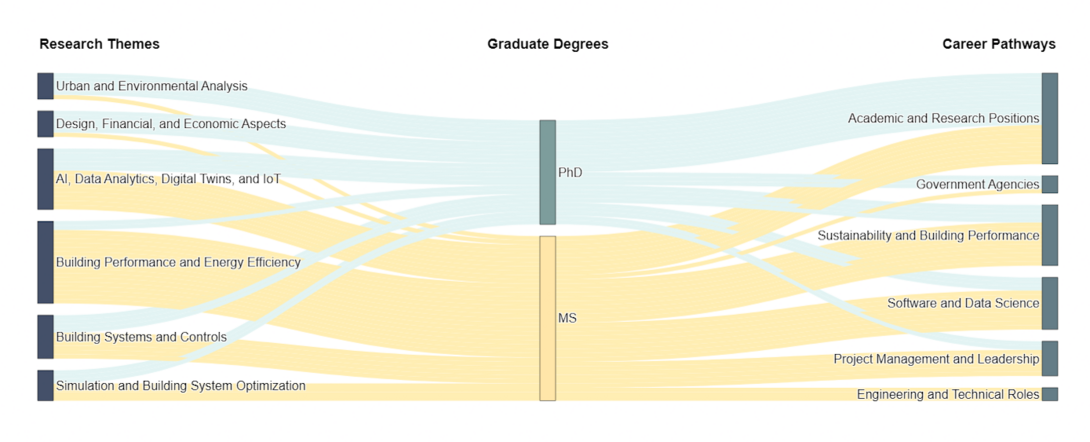
Graduates of the BPD programs are well-equipped for diverse career paths in architecture firms, engineering consultancies, sustainable design agencies, government institutions, and research organizations. The program emphasizes a comprehensive understanding of building performance and its societal, environmental and ecological impacts, preparing students to become effective leaders in sustainable architecture and design. This foundation positions them to contribute meaningfully to the evolving demands of the built environment.
Resources
BPD students benefit from access to Carnegie Mellon University's robust research environment and cutting-edge facilities. This includes the state-of-the-art Design Fabrication Lab (dFAB) and Applied Architectural Robotics Lab, which serve as a collaborative hub for faculty and students. Students also have access to the Center for Building Performance and Diagnostics and the Robert L. Preger Intelligent Workplace, facilitating interdisciplinary interactions focused on sustainability studies. Additionally, students have access to a state-of-the-art VR (virtual reality) lab.
Educational & Professional Qualifications
We seek students who are highly self-motivated and passionate about research, with a balanced aptitude in both the art and science of sustainable development and who understand the important role that the built environment must play if we are to create a sustainable future.
Program Faculty

Adjunct Faculty

Associate Professor & Associate Head for Design Research

Adjunct Faculty

Associate Professor, CBPD Co-Director, DDes Track Chair & Director for Student Relations

Professor & MSRSD Track Chair

Professor Emeritus

Special Faculty in Architectural Design & Assistant M.Arch Track Chair

Professor & Head

University Professor

Professor Emeritus

Associate Teaching Professor & AECM Track Chair

Professor Emeritus

University Professor & CBPD Co-Director

Assistant Teaching Professor

Professor of Practice
Associate Professor in Building Technology, BPD Track Chair & CBPD Co-Director
Admissions Resources
Are you a current student looking for resources? Handbooks, procedures, and other information can be found on the Student Resources page.