
Ph.D. in Architecture
PhD-Arch
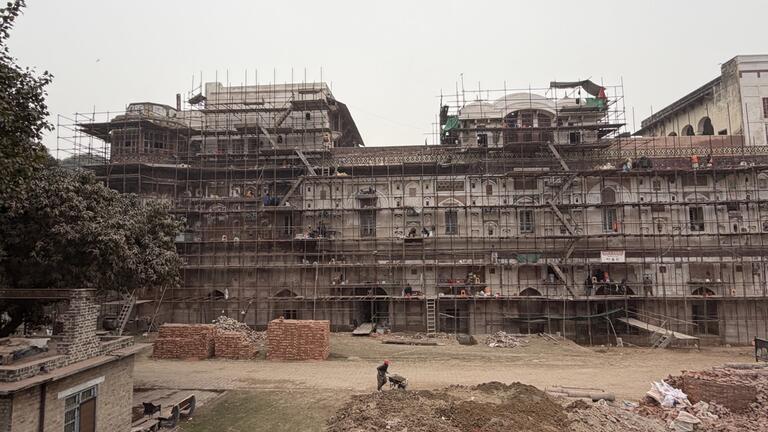
Infrastructures and labor of heritage preservation, Lahore Fort, 2026. Credit: Ifrah Asif
The Ph.D. in Architecture (PhD-Arch) program at Carnegie Mellon advances interpretive, critical, and contextual perspectives on architecture, landscape and urbanism. The program offers students an interdisciplinary platform to investigate built environment cultures, practices, and politics through qualitative, spatial and collaborative modes of research.
Jump To...
Associate Professor & PhD-Arch Track Chair

Program Overview
The Ph.D. in Architecture (PhD-Arch) program at Carnegie Mellon advances interpretive, critical, and contextual perspectives on architecture, landscape and urbanism. The program offers students an interdisciplinary platform to investigate built environment cultures, practices, and politics through qualitative, spatial, and collaborative modes of research.
Faculty in the program specialize in architecture and urban history, critical urban studies, cultural geography, environmental humanities, digital humanities, science and technology studies (STS), environmental justice, and community-oriented research across a range of historical and geographical contexts in the Global South and North. The program is enriched by course offerings and expertise in the humanities, arts, and social sciences from across CMU.
The intellectual foundation of the program is informed by Carnegie Mellon Architecture's commitments to racial and spatial justice in architectural epistemology, pedagogy and practice, and builds on and extends the foundational work of the school in the areas of community-oriented urban design and research. It is also supported by wide-ranging expertise and resources in the school and across the university, particularly in the arts and humanities.
We invite applicants with a strong interest in scholarly work and writing. Interested applicants should review the program faculty's research interests, and reach out with any questions. Applicants are advised to not use generative artificial intelligence (AI) tools to develop any portion of their communication or application materials.
Program Structure
Students work closely with their advisors throughout the course of the program. Coursework and advising during the first two years of the Ph.D., leading up to the qualifying exam, enable students to build a firm intellectual and interdisciplinary foundation for their dissertation. Students are also encouraged to engage courses and faculty outside the program, particularly in humanities and social science programs in CMU and at the University of Pittsburgh.
The program of study is marked by four milestones: the game plan, qualifier exam, proposal and dissertation.
- The game plan, to be completed approximately towards the end of the first year, provides an abstract of the project and the key areas of concentration, along with a schedule for coursework and research, and the advisory committee.
- Upon completion of their coursework, students work with their advisory committee to complete the written and oral qualifying examination. This allows them to demonstrate: 1) how they understand and apply scholarly practices and concepts in their field(s) of study; 2) how they synthesize ideas and think across these (sub)fields; and 3) how they situate their research in relation to established concepts and practice their own scholarly voice.
- The next milestone, the dissertation proposal, further details their project — its conceptual and methodological framework, contributions to the field, results of preliminary research, and a timetable for research and writing.
- The final milestone, the doctoral dissertation, is the summation of the students' work, which builds on, extends, and significantly contributes to research on built environment cultures and politics.
Alongside the development of their own research, Ph.D. students are also guided in developing and teaching courses related to their area of study, applying for grants, and sharing their research in academic fora and through publications.
The PhD-Arch curriculum is available here.
Program Faculty
For more information about the PhD-Arch program, please contact Track Chair Nida Rehman.

Associate Professor, CD Track Chair, CodeLab Director & Associate Dean for Faculty and Graduate Affairs

Associate Professor, CBPD Co-Director, DDes Track Chair & Director for Student Relations

Associate Professor, MUD Track Chair & RCI Director

Associate Professor & Associate Head for Design Ethics

Professor of Practice

University Professor
Associate Teaching Professor & IDeATe Associate Dean

Associate Professor & Situated Computation + Design Lab Director
Associate Professor & PhD-Arch Track Chair

Associate Professor

Assistant Teaching Professor
Admissions Resources
Are you a current student looking for resources? Handbooks, procedures, and other information can be found on the Student Resources page.