
Urban Moss: Interstitial Space as Micro-Infrastructure
Like moss — a plant known for its reciprocal benefits that create conditions for other species to thrive — this seminar explores how bottom-up interventions can foster a more vibrant public realm.
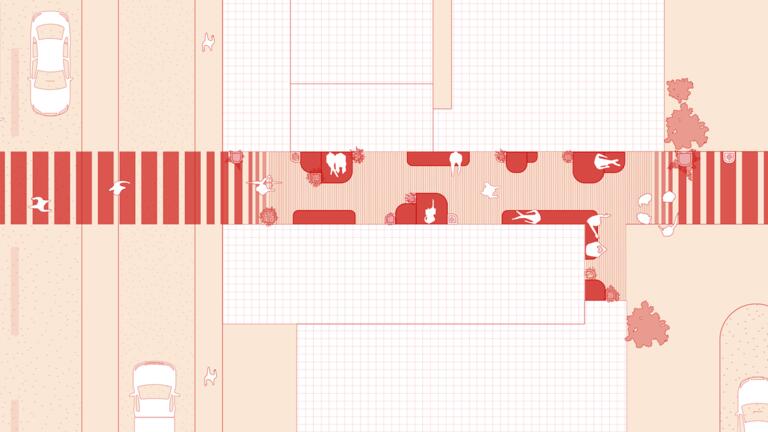
Lubbock Alleyway Proposal, Zineb Fokar.
This course investigates the potentials of micro-infrastructures built within the interstices of urban landscapes. Like moss — a plant known for its reciprocal benefits that create conditions for other species to thrive — this seminar explores how bottom-up interventions can foster a more vibrant public realm. Amid large-scale planning efforts, interstitial spaces often remain underutilized as a civic resource. This course positions these spaces as critical sites for experimentation and engagement with local communities.
Beginning with the emergence of public space theory in the 1960s, students examine how these ubiquitous residual spaces have been transformed and activated over time. Through the decoding of contemporary case studies and on-site fieldwork, students develop spatial propositions that operate reciprocally within the built environment, transforming underutilized spaces into a distributed network of socially and ecologically responsive interventions.