Design Fabrication
This core course interrogates the act of making, the logics of material behavior, and the evolving landscape of contemporary fabrication methodologies.
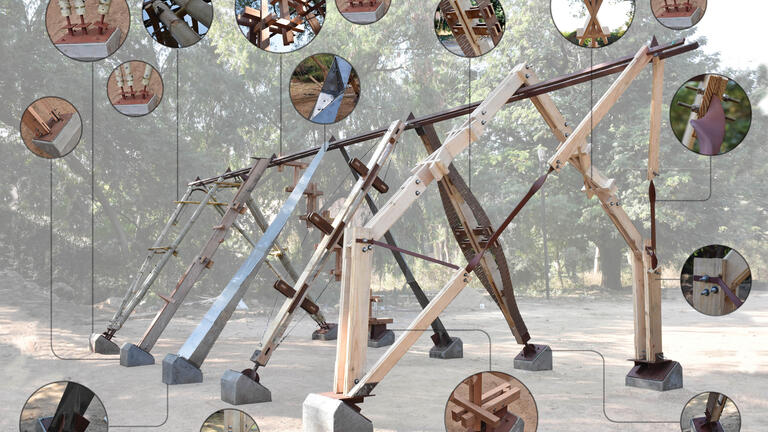
Making, Fabrication, Material Logics, Form Finding, Detailing, Tooling, Prototyping, Assembly.
This core course interrogates the act of making, the logics of material behavior, and the evolving landscape of contemporary fabrication methodologies. It offers an intensive, hands-on immersion into a diverse palette of materials — including timber, metal, plastic, bamboo, plywood, plaster, wire, and various natural and synthetic fibers — with the aim of cultivating a nuanced understanding of their intrinsic properties, performative behaviors, and spatial potentials.
At its core, the course emphasizes formal and tectonic inquiry through the generation of intricate geometries and assemblies. These explorations are deliberately situated outside the constraints of site specificity, client directives, or contextual mandates, thereby privileging a purist approach to material expression and fabrication intelligence.
Students are introduced to an array of analog and digital fabrication techniques, including but not limited to 3D printing, CNC milling and forming, vacuum forming, pressure lamination, hydraulic pressing, casting, weaving, and detail development for disassembly-oriented systems. Through iterative processes of making, the course nurtures tacit knowledge and intuitive sensibilities — both essential to advancing a "thinking-through-making" design ethos.
The pedagogical trajectory follows a progressive sequence — design, tooling, detailing, prototyping — enabling students to rigorously interrogate material performance and assembly logic. Emphasis is placed on the careful selection and synthesis of materials and fabrication strategies to yield inventive formal articulations across local, regional, and global contexts.
A critical component of the course lies in constructing a dialectic between materiality and form through the articulation of force and energy. Students investigate how composite systems — comprising both rigid and pliable materials — can be strategically deployed to exploit the interplay between stiffness and flexibility, whether innate or induced through manual or mechanized intervention. In this paradigm, material is not a passive recipient of pre-conceived form but rather an active agent in its generation.
The course delves into form finding, the intricacies of effective cross-sectional profiling, orientation strategies, joint typologies (e.g., pin, hinge, interlock), and operations of aggregation, subtraction and formation. These inquiries culminate in prototyping, where assembly logic and material intelligence converge in the realization of structurally and spatially resolved constructs. Coursework may be completed individually or in groups.