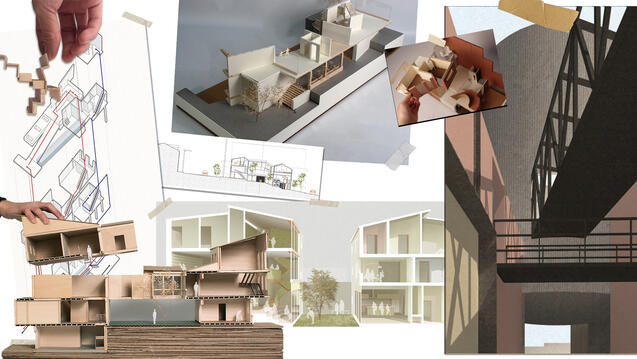
This studio nurtures a way of making and thinking in design that cultivates the practice of architecture as an act of creative citizenship.
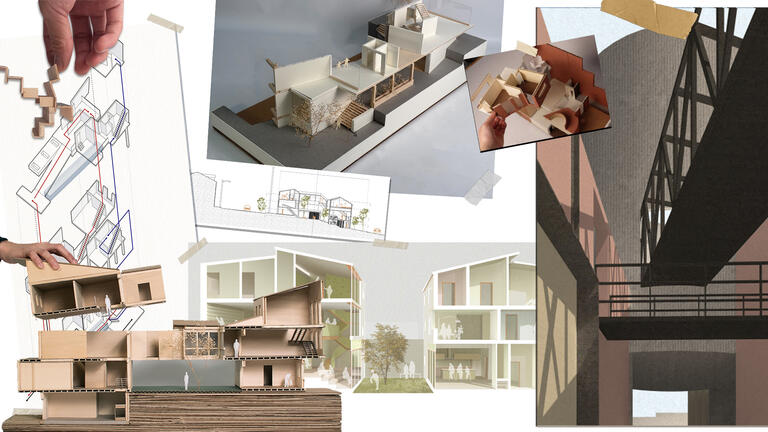
Poiesis II experiments by Allen Chen, Alobi Huang, Will Ivansco, Jioh Kim, Adeline Kwan, Estee Teo, Max Whalley and Lukas Yao.
This studio nurtures a way of making and thinking in design that cultivates the practice of architecture as an act of creative citizenship.
![Rothstein, Arthur. Cars parked along Allegheny River, Pittsburgh, Pennsylvania. 1938. Farm Security Administration, Library of Congress Prints and Photographs Division [detail] https://www.loc.gov/item/2017723800/.](/sites/default/files/styles/16_9_637x359/public/2024-10/48111_%20Torello%20-%20Francesca%20Torello.png.jpeg?h=ad77082f&itok=7MTMhX7x)
The city of Pittsburgh is our (permanent or temporary) home and the site of many of our studio projects. In this course, students start exploring Pittsburgh as built environment in which their work might be situated, as cultural context they need to interpret, and as creative material for their own work.

This course serves as an introduction to the type of equipment and methodologies utilized in architectural fabrication. Students develop a basic understanding of the field to leverage these processes to explore and represent the complex nature of their designs.

This is the second course in a two-course sequence that introduces students to a broad range of architectural drawing techniques and practices that document, communicate, and generate design possibilities.
Fulfills minor requirements for: Architectural Representation and Visualization, Computational Design, Architecture (non-majors)
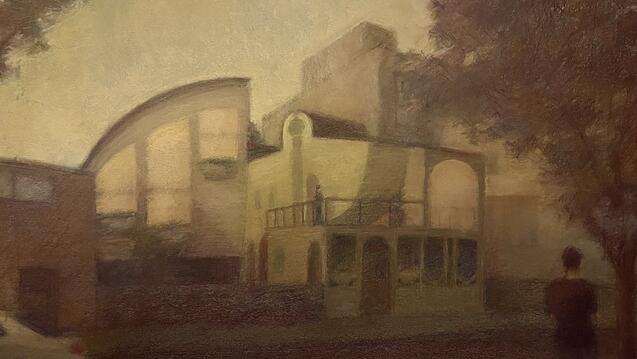
This course builds a capacity for visualizing three-dimensional space through freehand drawing, along with the use of line, tone, and color.
Fulfills minor requirements for: Architectural Representation and Visualization, Architecture (non-majors)

This course cuts a broad swath through time, geography and cultures, surveying critical episodes in the built environment of Europe, the Middle East, Asia, Africa, and the Americas from ancient times through the 19th century.
Fulfills minor requirements for: Architectural History, Architecture (non-majors)

This course focuses on how students learn, develop, and make decisions as they transition into architecture education.

This studio explores entanglements of ecological preservation in the face of climate collapse and genetic erosion. Centering on the seed vault as a critical typology, the studio reimagines preservation infrastructure not as passive storage but as active resistance.

This studio proposes the adaptive reuse of the Heinz Administration Building as an unlikely hybrid combining workforce housing with a civic urban bathhouse, framing adaptive reuse not only as a technical problem, but as an opportunity to rethink dwelling, civic life, and collective care in the post-industrial city.
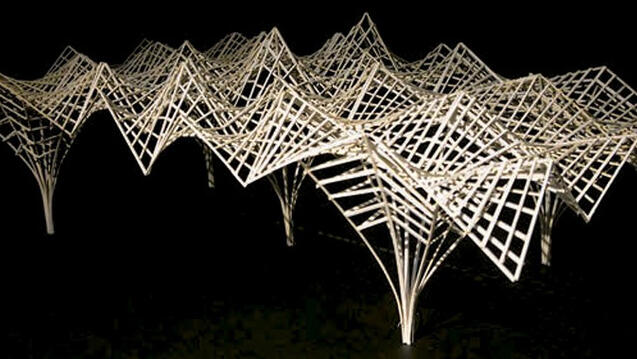
This studio examines how materiality, construction, detailing, assembly, and derived structural systems can shape the spatial organization, form, and experiential quality of a market square and public institution, treating structure and material as active generators of space.

This studio’s project is an International Fabric Arts Design Center dedicated to the creation, study, and exhibition of contemporary works in cloth and fiber. The project invites students to consider how process is evidenced in a final work and how the design of the workspace contributes to the process of artistic production.

This course investigates the history of a wide range of buildings, architecture, cities, landscapes, and theory across the 20th century around the world.
Fulfills minor requirements for: Architectural History, Architecture (non-majors)