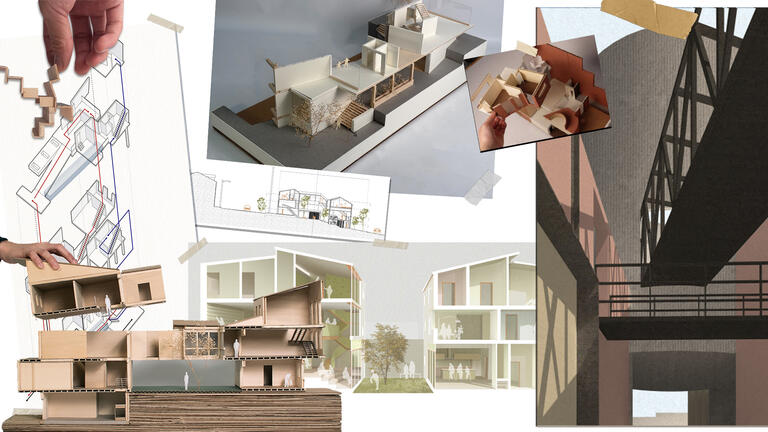
This course takes computers outside the box and outlines a journey of discovery revealing computation as connective tissue encompassing multiple facets of contemporary architectural practice and experience.
Fulfills minor requirements for: Computational Design
Spring 2026
Poiesis II experiments by Allen Chen, Alobi Huang, Will Ivansco, Jioh Kim, Adeline Kwan, Estee Teo, Max Whalley and Lukas Yao.
This studio introduces integrated architectural design as the synthesis of disparate elements, demands and desires. It situates architecture as a technological, cultural, and environmental process that is inherently contingent and entangled yet tethered to a historical project of autonomy.
This course introduces the fundamentals of strength of materials, computational modeling of structures, and basic finite element (FE) analysis. This is a hands-on, skill-building course about learning how to translate a conceptual design intent into a computational structural model, then applying material and boundary condition constraints to analyze and understand structural behavior.
This course explores the systems of economic, political, social, and regulatory forces driving the production of contemporary architectural projects.
Fulfills minor requirements for: Architecture (non-majors)
This course addresses the urgent need for sustainable building design in an era of climate change.
This course critically examines the professional practice of architecture through historical and contemporary lenses.
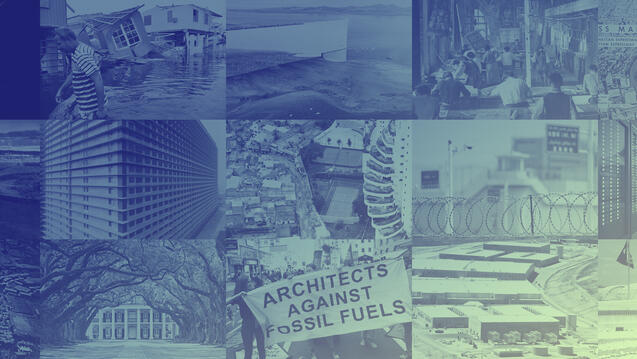
Architecture is inextricable from the uneven social, political, technological and environmental conditions shaping the contemporary world. With this reality as our starting point, we examine the complex intersections of ethics, power and space that often shape architects' choices.
Fulfills minor requirements for: Architecture (non-majors)
Working closely with local residents and grassroots activists in the town of North Braddock, Pa., this studio develops proposals for multiscalar repair that think with and build on the community's practices, expertise, and desires for place-making.
This studio positions architecture as a translational practice operating between geological processes and architectural systems, prioritizing translation over representation.
This studio investigates Future Fictions of Florida’s coastal towns, where culture, tourism, ecology, infrastructure, and capital collide.
This studio directs attention to the design of urban house prototypes as multi-scalar instruments. We treat the house not merely as a shelter, but as a site for disciplinary experimentation capable of reimagining how we might live within the idiosyncratic landscapes of the perforated city.
This studio asks how architecture might emerge from direct sensory experience, empathetic listening, and shared understanding, rather than form or image alone.