
Remote video URL
[Symposium] Making Alive: Reworlding Cities! Decommodified · Regenerative · Pluriversal
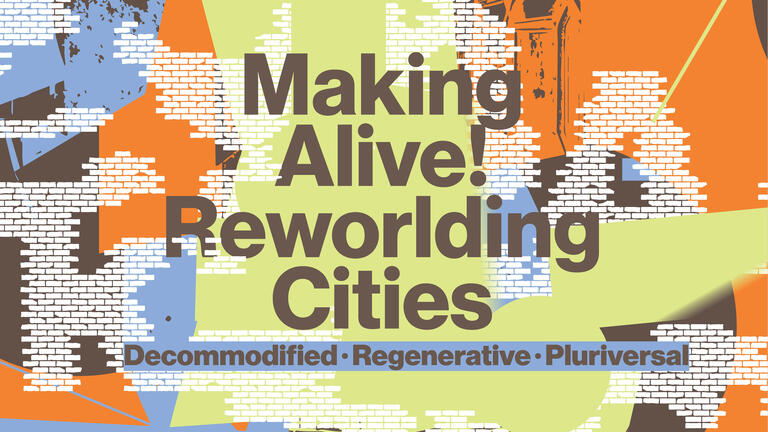
Making Alive! Reworlding Cities: Decommodified · Regenerative · Pluriversal
Making Alive! Reworlding Cities: Decommodified · Regenerative · Pluriversal
Symposium with Keynote Speakers Prof. Arturo Escobar and David Bollier
Tuesday - Thursday, March 10–12
Hosted by Carnegie Mellon’s Remaking Cities Institute, this symposium brings together scholars, designers, activists, and community partners to reflect on how cities are being reshaped under conditions of financialization, ecological crisis, and uneven post-industrial change. Anchored in Pittsburgh yet attentive to broader systemic dynamics, the program considers both large-scale urban infrastructures and everyday architectures of collective life. Through dialogue, site-based inquiry, and cross-disciplinary exchange, participants explore how ownership, governance, material cycles, and shared stewardship are negotiated in practice. Rather than offering fixed solutions, the conversations invite sustained reflection on the ontologies of cities—how they are understood, structured, and inhabited—and on the possibilities of reworlding urbanism through relationality, repair, and collective responsibility.
The symposium is chaired and organized by Stefan Gruber, Sarosh Anklesaria and Tuliza Sindi.
All events will provide catering. PLEASE REGISTER through this FORM by midday on Monday, March 9, 2026, so that we can finalize all catering and venue capacity planning.
SCHEDULE:
Tuesday, March 10 · 5:30–8:00 pm
Keynote Opening Conversation
Cities: Pluriversal and Alive
_Site: Frank-Ratchye STUDIO for Creative Inquiry, CFA, 4919 Frew Street, Pittsburgh, PA 15213
_Keynote Speakers: David Bollier (2026 David Lewis Lecture), Arturo Escobar ( 2025-26 Watson Chair)
_Symposium Chairs: Sarosh Anklesaria, Stefan Gruber, Tuliza Sindi
_Guiding Questions: How does a pluriversal understanding of the world change how we conceive, design, and govern cities? What urban places, institutions and practices of commoning might help defend shared wealth from enclosure and make cities more “alive” in social, ecological, and political terms?
Wednesday, March 11 · 09:00 am–7:00 pm
_(9-9:45am) Tour (incl. meeting point): Walking Tour of Downtown with Bruce Chan, Pittsburgh Downtown Partnership. Meeting point: Westin Hotel lobby, 1000 Penn Ave., Pittsburgh, Pennsylvania, 15222
Morning Panel Session 10:00 am - 1:30 pm
Ownership: Decommodified and Cooperative
_Site: 20th floor of Frick Building, 437 Grant Street, Pittsburgh, PA 15219 (please sign in at the security desk)
_Guest Speakers: Susanne Schindler, Neeraj Bhatia, Randall Taylor
_Poet: Sten Carlson, Adrea Cha
_Faculty Participants: Jared Abraham, Jonathan Kline, William Martin
_Guiding Questions: How might cities move from ownership toward stewardship—shifting cultural norms, legal frameworks, and property regimes to support collective responsibility and care? What mechanisms—cooperatives, CLTs, nonprofit ownership, temporary use, adaptive reuse—could mobilize vacant or underused buildings into shared urban assets?
Remote video URL
_Lunch
Afternoon Panel 2:30 pm - 5:30 pm
Infrastructure: Relational and Redistributive
_(1:30pm) Bus Transfer: departure to City of Asylum, with a stop along State Route 65 between Manchester and Chateau
_Site: City of Asylum, 40 W North Ave, Pittsburgh, PA 15212
_Welcome: Alexis Jabour; City of Asylum
_Guest Speakers: Karen Abrams, Jesse LeCavalier, Clare Lyster
_Poet: Charles Legere
_Faculty Participants: Sarosh Anklesaria, Christine Mondor, Richard Nisa
_Guiding Questions: How do infrastructures—physical, social, and digital—shape relations between neighborhoods, ecologies, and institutions? How might we design infrastructures that redistribute resources, risks, and opportunities across social and ecological boundaries?
Remote video URL
_Reception at Alfabeto / City of Asylum
Thursday, March 12 · 10:00 am–7:00 pm
Morning Panel Session 10:00 am - 12:30 pm
Metabolism: Adaptive and Regenerative
_Site: Construction Junction, 214 N Lexington St, Pittsburgh, PA 15208
_Welcome & Tour: Melissa Mongelli; Construction Junction
_Guest Speakers: Lola Ben-Alon, Gideon Kossoff, Adrienne Economos Miller
_Poet: Emily Carlson
_Faculty Participants: Dana Čupková, Joshua Lee
_Guiding Questions: How can urban metabolisms—flows of energy, materials, food, and waste—be reoriented toward regenerative cycles rather than extractive linearities? Where do adaptive reuse, circular economies, and practices of repair, cultivation, and maintenance reveal alternative metabolic relations between city and territory?
Remote video URL
_Bus transfer to Community Forge (for students joining the afternoon session only, a bus will leave from the Margaret Morrison Rotunda a 1:20pm to Community Forge)
Afternoon 1:00 pm - 5:30 pm
Agency: Distributed and Collective
_Site: Community Forge, 1256 Franklin Avenue, Pittsburgh, PA 15221
_Welcome: Jackie Cameron, Mike Skirpan, Patrick Cooper; Community Forge
_(1:00-1:40 pm) Lunch
_Guest Speakers: Tei Carpenter, Gilly Karjevski, Cassim Shepard
_Poet: Robin Clarke
_Faculty Participants: Maryam Karimi, Stephanie Kyuyoung Lee, Nida Rehman, Tommy CheeMou Yang
_Guiding Questions: How can agency in cities be understood as distributed across communities, institutions, and more-than-human actors rather than concentrated within experts or markets? Where do collective design processes, civic cooperatives, and participatory or activist planning practices demonstrate how urban transformation can emerge from shared authorship and situated knowledge?
_(4:30pm) Reading Performance: Samizdat / Audience (Vaclav Havel, 1975) by Jeffrey Carpenter and Steven Michael Wilson of Bricolage Production Company
Remote video URL
More Information
-
We are grateful for the support of the Frank-Ratchye Studio for Creative Inquiry, which helped make the keynote gathering possible. Thank you to our community partners across Pittsburgh who hosted the sessions, including CBRE Real Estate, City of Asylum, Community Forge, and Construction Junction.
Within Carnegie Mellon, we are grateful for the participation of many colleagues in the School of Architecture and the School of Design. A special thank you to Will Martin, who curated the poetry that accompanied the sessions.
We also want to recognize the many research assistants and students who were a part of organizing the symposium: Tamnua, Cyphanah, Taki, Yumeng, Joseph, Russell, Jerome, Ada, Aren, and Laghima. Your work behind the scenes is what made the gatherings possible.
-
The symposium was been made possible through the generous support of several sponsors, including the PJ Dick Innovation Fund (for Projects), The New Institute in Hamburg, the David Lewis Lecture, the Jill Watson Fund, and the Rider Fund from CM-A Public Programs.