
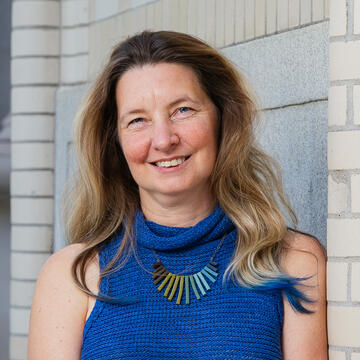
Christine Mondor
Christine Mondor has taught at Carnegie Mellon’s School of Architecture since 1999 and is founder and strategic principal at her design practice, evolve environment::architecture. In both her teaching and practice, Mondor builds interdisciplinary teams to study sustainability and urban systems with a focus on urban environments, ecology, and infrastructure.
Within Carnegie Mellon Architecture, Mondor teaches architecture, urban design, and landscape at the undergraduate and graduate levels and mentors interdisciplinary student projects. Mondor’s courses explore the role of the designer and the community in creating and administering urban systems, and she has taught technical and design courses including Infrastructure Studio, Urban Ecology, Site Engineering, Human Factors in Architecture, History of Sustainable Architecture, and History of Landscape Design.
Mondor received her B.Arch from Carnegie Mellon University and studied sustainability in Scandinavia. She is currently studying sustainable cities at Harvard University. Mondor was named as a Fellow by the American Institute of Architects (AIA) and has many professional certifications.
Mondor studies decentralized urban infrastructure and how water, energy, food, and mobility systems lead to physical and cultural resiliency. Her work focuses on technologies, system structures, and social practices that contribute to the transition of infrastructure systems. She does so with a dual focus on design and empirical research, and she frequently works on interdisciplinary projects. She has led research teams studying post-occupancy evaluations, green infrastructure implementation, and urban integrated solar production. She has been tapped to define best practices for national frameworks and has developed strategic documents for municipal, city, and state governments.
Mondor’s research interests extend into her practice, where she has produced citywide green infrastructure plans for Buffalo, N.Y., and Pittsburgh, Pa., as well as mobility network planning. Her projects have advanced equitable resiliency practices for cities and municipalities through the creation of place-forward energy plans, resiliency plans, and air quality planning. Her integrative practices have shaped national ecodistrict frameworks, and her work has received national recognition from the AIA and the American Planning Association (APA).
Mondor’s research and design work has been published internationally in professional publications including “Architect” magazine, the “Journal of Green Building,” the “International Journal of Architectural Computing,” and in books by the MIT Press. She has shared her work at academic and professional conferences and brought her research to the public through her TED Talk.
Affiliations