Design Research Clusters
Jump To...
Carnegie Mellon Architecture (CM-A) is accepting proposals for Design Research Clusters — teams of at least four faculty organized around a shared theme/problem space to conduct work, impact future pedagogy, engage external partners, and disseminate new knowledge. Clusters will be partially supported for an initial phase of six (6) years.
Over the past five years, we have worked together to develop a supportive design research environment at Carnegie Mellon Architecture. This has included establishing the PJ Dick Innovation Fund, new professional leave and course buyout policies, increased financial support for Ph.D. students, CM-A labs, and inaugurating the 6555 Penn Avenue research facility. These efforts have and aim to support a diverse set of research, scholarship, and creative activities across our faculty that will further the mission of the school, increase our impact, and enhance student experience.
Yet during this same period, the school's larger scale research footprint has decreased. Team-led, multiyear projects with external funding have become harder to realize. Given the building blocks we have in place, this is the problem we would like to collectively address through a call for proposals to form design research clusters within CM-A.
The goal of this initiative is to provide faculty with the incentives, resources, and time to build design research teams around shared themes that have the potential to catalyze collaborative work over a 5-6 year timeframe. Another motivation of this effort is to provide more targeted levels of support from the College of Fine Arts (CFA) and university partners, with a focus on team formation and project development such that teams can successfully raise funds to support the creation and dissemination of their work.
The proposed framework seeks to address the following questions:
- How can we scaffold toward collaborative, multiyear design research projects with medium to large scale funding prospects centered around the school's mission?
- How can we encourage collective work around shared problems/interests from different points of view and research modalities?
- What resources and support will encourage team formation and project development?
Framework & Supports
Design Research Clusters Framework
Design research clusters will be teams of CM-A faculty (at least four total) organized around a shared theme/problem space to conduct work, impact future pedagogy, engage external partners, and disseminate new knowledge. Clusters will be supported for an initial phase of six (6) years.
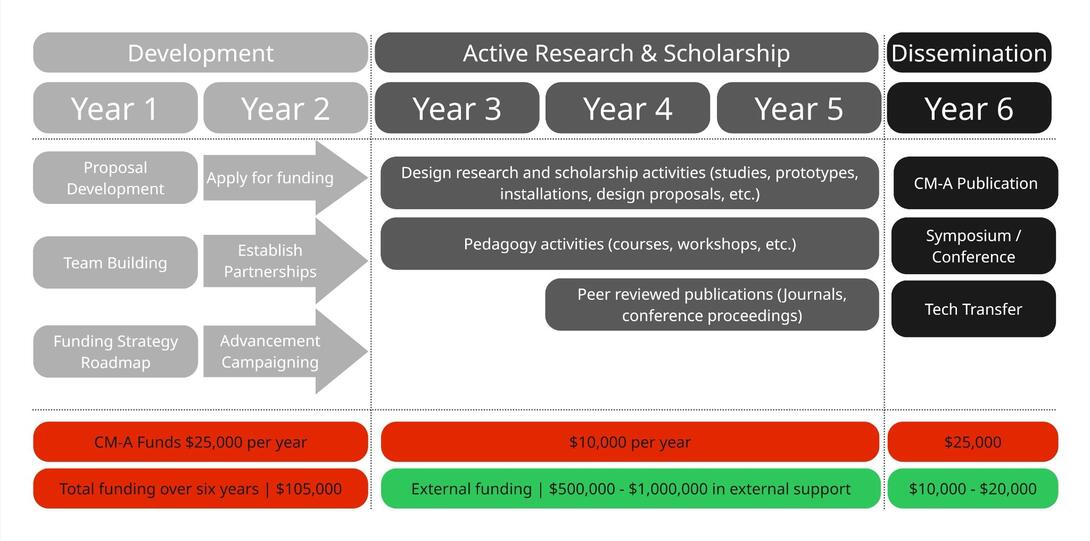
The proposed framework includes two years of project and team development primarily supported by CM-A. This leads into three years of design research and scholarship activity with continued base support from CM-A and primary funds raised from external sources. In year 6, the school will support the dissemination and continuance of the work with the potential of continued external funding extending the future activities of clusters. CM-A will fund up to two proposals in the first cycle.
Years 1-2 | This phase is focused on pre-project development, including team formation, developing an initial track record of collaboration, creating a funding strategy roadmap, beginning to apply for grants, and/or building relationships with foundations/donors/industry partners. The CFA Research & Creative Practice (RCP) team will provide support during this phase.
Years 3-5 | During this phase, teams will conduct the bulk of the design research activity within the team. External support for the work should sustain the effort. Outputs should build on each other towards a coherent body of work. Approaches and outputs can range under a big umbrella approach to design research and can also include interaction with the school's pedagogy.
Year 6 | After the bulk of the work has been completed, attention can turn toward dissemination of the yearslong effort. Each project will likely suggest a different approach, but this phase could include publications, symposia, technology transfer, and/or exhibitions.
Cluster Supports
Over a two year timeframe, the school can support teams to develop a track record of collaboration, engage external partners, articulate their mission, refine their strategy, and apply for funding. Over the subsequent three years, teams will fund the bulk of their activities through external support. In year 6, the school will support dissemination of the work based upon the particular outcomes of each cluster.
Supports Provided to Design Research Clusters by Year
*Funds can be used for faculty summer salary and benefits, RA support, Ph.D. student support, supplies, travel, etc. in support of developing design research clusters.
**CM-A Policy for Teaching and Administrative Release applies.
Teams & Eligibility
Teams should be composed of cluster leads (2-3 CM-A faculty), CM-A cluster members (minimum 2 CM-A faculty), and external team members/partners (CMU faculty, industry, community, etc.).
Research Cluster leads | must be full-time CM-A faculty on the teaching, tenure or tenure track, with a minimum three year contract and should plan to participate in the duration of the cluster.
Research Cluster members | can be any current, full-time (or part-time special faculty) CM-A faculty member and may have a shorter duration engagement with the cluster based on their individual appointments. Members can cycle in and out of the cluster during its lifespan.
External partners | cannot be directly supported with CM-A funds, but they can be financially supported through external funding.
Timeline & Submission Details
Proposal Timeline
Proposals are due on Monday, October 26, 2026, at 11:59pm ET.
Submission Details*
Proposals will be accepted via a Google form. Information and documents to be uploaded are described below.
- Cluster/Team Details
- Cluster title
- Cluster Leads (names, appointments)
- Cluster Members (names, appointments, departments, emails)
- External Partners (names/entities, titles, primary contact)
- Abstract
- Provide a summary of your design research cluster, its areas of focus, and its potential impact. (up to 250 words)
- Key Image
- Upload an image that exemplifies the proposal and include an image credit.*
- Project Description
- Provide an overview of the Design Research Cluster (the who, what, when, where, how and why). Upload the project description as a single PDF. Supporting images, figures, and tables are welcome. (3,000 to 5,000) words):
- Vision: Why is your proposed area of design research important? Proposals should describe a compelling design research theme with interrelated topics that relate to the school's core mission, have contemporary valence, and show promise for multiyear support. Describe the shared problem space of your team and the potential impact of your work.
- Team: Who will conduct the work of the cluster and why is this combination important to the work's success? Proposals should describe the team required to conduct this work, including CM-A faculty, students, and external collaborators, and how the team members contribute to the project. Proposals should describe prior work that validates the team's expertise and positions the team for success in the proposed work.
- Methodologies: How will diverse approaches, methods, or frameworks be used to further the work and inform each other? Proposals should map out potential funding strategies that would support the team's efforts over a 3-5 year timeframe (this can be a first pass and will be refined if the proposal is selected in conversation with the CFA research team). Proposals should articulate resources required to conduct this work (including existing resources and new resources).
- Outcomes: What outcomes will result if funded? Proposals should describe the anticipated results of the work, taking into account the possibility of building incremental milestones towards larger outcomes in years 4-6, and developing a strategy to curate potentially diverse outcomes into a coherent body of work.
- Plan: When will the work happen? Proposals should map out a timeline of planning, design research activities, outputs and dissemination. Use the three Design Research Clusters phases to help organize the plan: Development (years 1-2), Active Research and Scholarship (years 3-5), Dissemination (year 6).
- Preliminary Budget: Provide a brief budget sketch of how you plan to use CM-A supporting funds ($25k per year) in the first two years of development. Proposals do not need to provide a budget for all six years. These will be further developed in years 1 and 2.
- Provide an overview of the Design Research Cluster (the who, what, when, where, how and why). Upload the project description as a single PDF. Supporting images, figures, and tables are welcome. (3,000 to 5,000) words):
- Supporting Work Samples
- Provide links or upload a single PDF illustrating previous or in-process work related to your proposal.
*Submission information may be used by the school to publicly announce and promote the grant program.
Funding Requirements
- In the first year, teams will be required to work with grant administrators and the CFA RCP team to develop a more comprehensive funding roadmap.
- Recipients will be required to provide periodic progress updates.
- Recipients are expected to be in regular communication with grant administrators and the CFA RCP team throughout the period of performance to discuss funding and dissemination strategies.
- Recipients may be asked to provide materials or engage in outreach activities related to the PJ Dick Innovation Fund.
- Recipients may be required to present their projects at a public event following the close of each funding cycle.
- Understanding that this is a pilot program, we will likely experience changes and incorporate suggestions along the way. Some flexibility should be anticipated.
FAQs
-
We recognize that there is a plurality of work happening within the school. Faculty should not feel pressured to fit their work into this framework. We will continue to support and celebrate individual scholarship, ongoing collaborations, creative practice, and research from the faculty. No one will be required to participate in a research cluster.
-
No, we plan to finish out the remaining cycles of the PJ Dick Innovation Fund as we originally planned and to seek continued funding to maintain the program into the future. Similarly, we will continue to find and maintain opportunities to support a variety of work within the school moving forward.
-
We welcome proposals from any of the school's labs or research centers with a critical mass of at least three CM-A faculty. We would also encourage existing labs and centers to see this as a moment to connect with the broader faculty and find opportunities for collaboration. This could also be an opportunity for labs/centers to join together around shared themes.
-
Shared themes are a middle layer between the broad mission of the school's three challenges and the particular interests and projects conducted by individual faculty members. There are many areas of overlap among faculty working in shared problem spaces from different vantage points. Shared themes should have broad resonance with clear potential impact. Themes should also be connected to the unique and specific capacities of each team.