PJ Dick Innovation Fund Teaching Grant: Ethics and Decision Making in Architecture

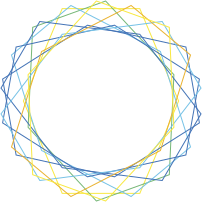
Nexus-Artery and Reservoir, a taxonomy for an embodied perception of infrastructures. Image credit: Maryam Karimi.
Ethics and Decision Making in Architecture
Instructor: Maryam Karimi, Special Faculty, Carnegie Mellon Architecture
Teaching Assistant: Ronishka Sabu Nalpathil, PhD-Arch student
This seminar confronts the ethical imperatives of architectural practice amid intersecting crises: climate collapse, technological acceleration, and structural injustice. Anchored in Carnegie Mellon’s ethos of critical praxis, it recasts design not as neutral problem-solving, but as a philosophical and political act, a making-with the world that entangles the architect in struggles over power, subjectivity, and the conditions of collective life.
We cultivate an ontology that faces the dark side of the Anthropocene by unsettling inherited narratives of human mastery and domination. Rather than treating the environment as a passive backdrop for human projects, we approach the world as a lively field of forces with its own propensities and agencies. Landscapes, materials, atmospheres, and species are engaged as co-actors in a shared, more-than-human field. Within this frame, design becomes a practice of attunement: learning to sense, negotiate, and collaborate with the trajectories of soils, waters, climates, and other beings.
In parallel, we examine how contemporary technologies, and AI in particular, no longer simply extend human capability but reconfigure the very conditions of agency. Modern technics do more than accelerate workflows; they organize, mediate, and distribute what counts as knowledge, creativity, authorship, and “world.” Generative systems blur the boundary between tool and collaborator, raising urgent questions of responsibility and control.
Pedagogically, the course pauses the rush to make in order to ask: Why build at all, and for whom? Through readings, discussions, and speculative design exercises, students develop an inquiry-driven lens and prototype ethical, relational practices that work with, rather than against, the forces that shape our world — bringing more just and livable futures into view.
Image: Nexus-Artery and Reservoir, a taxonomy for an embodied perception of infrastructures. Image credit: Maryam Karimi.
About the Project Lead
Special Faculty

-
Established in 2023 by PJ Dick Trumbull Lindy Group, the Faculty Grants Program will award a total of $400,000 over four years beginning in 2024. The program supports faculty research and teaching innovations that address the School’s three pedagogical challenges of climate change, social justice and artificial intelligence. The proposals were assessed on their impact in furthering a faculty member’s research and teaching, their contribution to interrogating the School’s challenges, and their viability to garner further research support, make an impact on the discipline and expand the pedagogy of the School.