
Announcing the Recipients of the 2025-26 CodeLab Grant
A research gift from Autodesk supported a new program of competitive grants funding exploratory research and pedagogical experiments at the crossroads of artificial intelligence (AI) and design at Carnegie Mellon Architecture's CodeLab (Computational Design Laboratory).
Four collaborative teams comprising CodeLab and other CM-A faculty and students were awarded grants this year by a jury including professors Francesca Torello, Omar Khan, Daniel Cardoso Llach, and Athina Papadopoulou (NYIT).
-
CodeLab is Carnegie Mellon Architecture's (CM-A) research and learning laboratory rethinking the role of computing in design and the built environment. Fundamentally interdisciplinary and experimental, CodeLab's faculty and students bring together methods from architecture, engineering, art, and the humanities to critically reimagine the interplay of computing, space and design.
One of the school's research institutes, CodeLab operates as a "lab of labs" with affiliated faculty leading research groups and laboratories with autonomy, an experimental disposition, and a shared emphasis on critical technical practice. Current research explores subjects such as architectural robotics, artificial intelligence, architectural digital heritage, computational design of structures, tangible interaction, as well as historical and sociotechnical questions concerning computing in architecture and other creative fields.
View a collection of recent CodeLab theses and dissertations and a selection of recent projects and publications.
-
The CodeLab Grant supports creative research, pedagogical projects, and critical perspectives at the intersection of design, computing, and the built environment. The grant aims to recognize a wide range of projects, particularly those that:
- Advance creative research, pedagogical agendas, or critical perspectives at the intersection of design, computing, and the built environment.
- Strengthen or instigate new research groups and labs comprising Computational Design faculty and students, including collaborations with other CM-A and/or CMU faculty and programs.
- Illuminate contemporary subjects such as AI, machine learning, and robotics, and problematize their entanglement with questions of creativity, materials, labor, or the environment.
- Take a cross-disciplinary perspective by drawing on methods from the arts, humanities, social sciences, and technical fields. Proposals involving historical and sociotechnical questions and methods, for example, are equally welcome as those centered on technical or application-focused research.
Faculty in Carnegie Mellon Architecture's' Computational Design (CD) program, including those in the tenure, teaching, and special faculty tracks, are eligible to apply. CM-A faculty members outside of CD are invited to apply as co-applicants with a CD faculty member. Joint projects and collaborations between CD faculty and faculty in other CM-A programs — and in other university units — are especially encouraged.

Diderot's Database: Deploying Machine Learning Data for Human Empowerment and Creativity
Team: Vernelle A. A. Noel, Assistant Professor, School of Architecture
Joshua D. Bard, Associate Professor, School of Architecture
Dina El-Zanfaly, Associate Professor, School of Design
Given the veritable arms race to capture human dexterous gestures for machine learning applications in robotics, how can we establish best practices for demonstration capture, expand access to archives of human demonstration data, and broaden the imagined applications of machine learning in communities of craft and manual skill? In the spirit of Diderot's "Encyclopédie" — an Enlightenment project best known for its radical inclusion of the mechanical arts in the core taxonomy of human knowledge — our team will explore the creation, curation, and application of human demonstration data archives through a survey of capture practices and first-hand experiments capturing and archiving data.

Unruly Ruled Surfaces: Experiments in Tensile Birch Bark Membrane Structures
Team: Matthew Z. Huber, Special Faculty, School of Architecture & CodeLab
Research Assistant (TBD), School of Architecture
Birch bark is a traditional building material with remarkable qualities — tensile strength, pliability, and water resistance. It was once treasured for use in rice baskets, cladding, and canoe construction by Indigenous peoples in North America, and for roofing, waterproofing, woven shoes, and utensils in Scandinavia. However, this unique forest product is now largely discarded as waste byproduct in industrial timber processing, largely due to its "unruly" or non-standard behavior. This project proposes a computational process to scan, map, and predict the geometric behavior of this natural material for use in panelized, stitch-fastened tensile membrane structures through the design and fabrication of a prototype shade structure.

Why AI Workshops: Building Critical Fluencies at the Intersection of Design Research and Artificial Intelligence
Team: Daragh Byrne, Associate Teaching Professor, School of Architecture & CodeLab
This experimental workshop series bridges pedagogy and research to cultivate critical AI fluencies through research-through-design methods. Five intensive weekend workshops engage students in questioning, dismantling, and reimagining AI — moving beyond tool use to critical inquiry into intelligence, creativity, and computational practice. Students employ methods including critical making, speculative prototyping, and comparative analysis to produce tangible artifacts (books, visualizations, films) while examining AI's metaphors, mechanisms, values, and creative implications. The series pilots pedagogical approaches that can lead to an Advanced Option Studio, generating publishable research on critical AI pedagogy while strengthening CodeLab's commitment to problematizing AI’s entanglements with design, materials and environment.
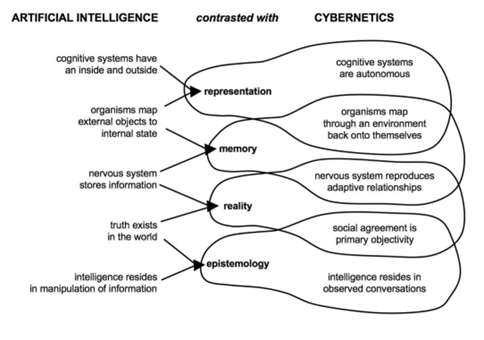
Unspoken Continuity: Re-Braiding Cybernetics & Artificial Intelligence
Team: Paul Pangaro, Adjunct Faculty, Laboratory for Cybernetics Director (Lab4C) & CodeLab Visiting Scholar, School of Architecture
Jill Fain Lehman, Senior Project Scientist, Human Computer Interaction Institute & School of Computer Science
The Re-Braiding Cybernetics & Artificial Intelligence Project seeks to bring these two fields back into conversation to enrich their respective approaches to machine intelligence and human-machine collaboration. This proposal seeks funding for faculty and student support for the design, curation, and dissemination of the critical dialectic that emerges from a series of mini symposia with important researchers of prior and current eras of these two fields. The mini symposia will move through timely themes based on histories and critiques, coupled to a month-by-month evolution of critical topics with impact on the future of AI in society.